
Aviator and the 1.00x Instant Crash
Aviator is a crash game by Spribe built around an increasing multiplier and a plane that can disappear at any moment. The round starts at 1.00x, the multiplier rises, and the player must cash out before the crash.
The instant 1.00x crash is the clearest sign of how the game’s mathematics works. About 3% of rounds end at 1.00x, or roughly one round in 33, and those results help produce the game’s stated 97% RTP and 3% house edge.
How Aviator Works
Spribe describes Aviator as a social multiplayer game with an increasing curve that can crash anytime. Each round lasts about 8-30 seconds, with 60-90 rounds possible in an hour.
The crash point is fixed before take-off, although players do not see it in advance. A player wins by sending a cash-out request before the multiplier reaches that point.
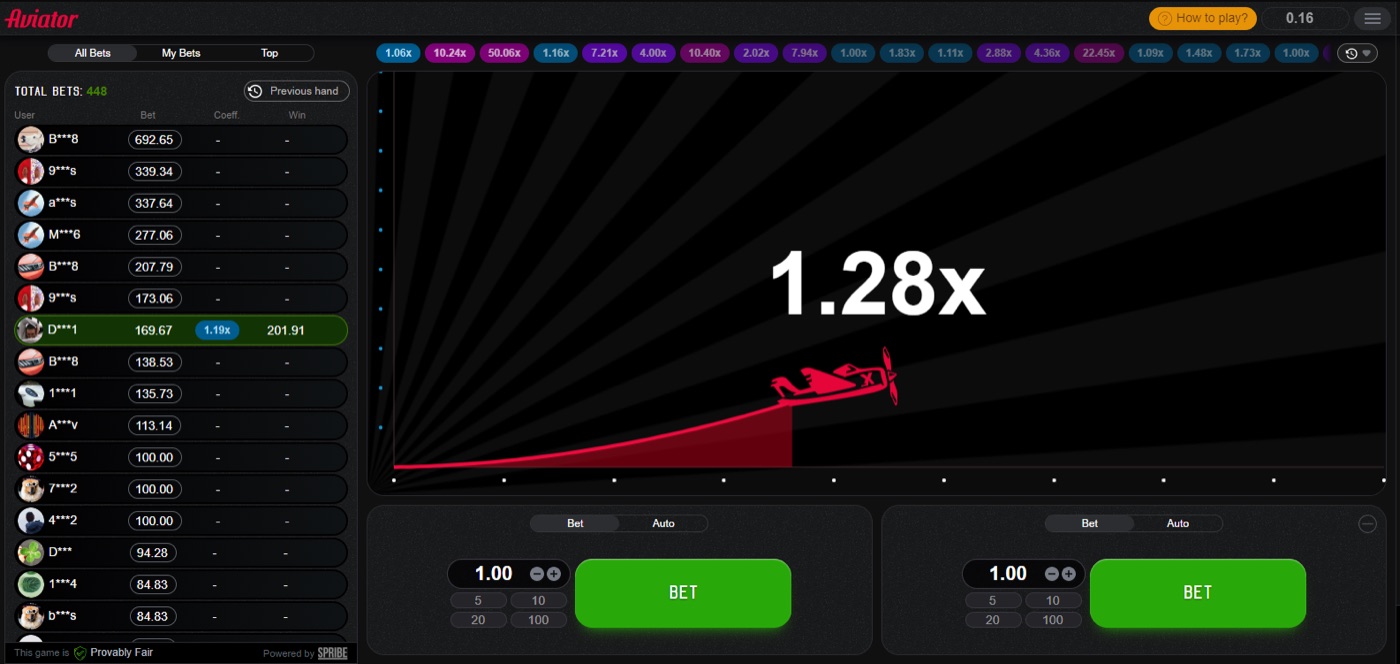
The Aviator plane rises while the multiplier increases before the crash.
The basic round sequence has several separate stages:
- Players choose one or two stakes in the available bet panels.
- The plane takes off and the multiplier begins to increase.
- Players cash out manually or use a preset Auto Cash-Out value.
- The round ends when the hidden crash point is reached.
- Any stake that has not been cashed out before the crash loses.
Aviator has two bet panels, so one round can contain two separate stakes and two separate cash-out decisions. The Bet and Auto tabs control the way a bet is placed, while Auto Bet and Auto Play can cover 10-100 rounds with stop-on-win and stop-on-loss settings.
The game is not a slot and has no bonus round. It runs in desktop, tablet and mobile browsers, including devices with low bandwidth and budget hardware.
What 1.00x Means
Aviator’s 1.00x crash means that the round ends at its starting multiplier. About 3% of rounds crash instantly at 1.00x, which is roughly one out of every 33 rounds.
The result does not mean that the multiplier moved to 1.00x and then stopped after a long wait. It means the predetermined crash point was 1.00x, so a player who did not cash out before the crash receives no winning return.
The one-in-33 figure is an approximate way to express the 3% rate. It is not a schedule that forces an instant crash after 32 other results, because rounds are independent.
- A run can contain no 1.00x crash for more than 33 rounds.
- A run can contain an instant crash soon after another instant crash.
- Previous multipliers do not make the next round due to rise.
- A visible history of results does not change the next crash point.
This independence matters because players may look for patterns in the round-history display. A sequence such as 1.10x, 2.00x, 1.30x and 5.00x does not create a reliable prediction for the next round.
The instant crash also explains why a low cash-out target cannot guarantee a win. A target below 1.00x is not available, and the 1.00x outcome occurs before the multiplier can reach targets such as 1.20x or 1.50x.
The House Edge Numbers
Aviator lists RTP at 97%, which gives the game a 3% house edge. The expected value is minus 3% of the stake at every cash-out target.
The 3% edge includes the rounds that crash at 1.00x and the rounds that reach higher multipliers. A higher target changes how often a bet wins, but it does not remove the edge.
The stated probability that a round reaches multiplier m is 0.97 divided by m. The following values show how the chance of reaching a target falls as the target rises:
| Target multiplier | Probability of reaching it | Approximate result |
|---|---|---|
| 1.20x | 80.8% | About 4 in 5 rounds |
| 1.50x | 64.7% | About 2 in 3 rounds |
| 2.00x | 48.5% | Just under half |
| 3.00x | 32.3% | About 1 in 3 rounds |
| 5.00x | 19.4% | About 1 in 5 rounds |
| 10.00x | 9.7% | About 1 in 10 rounds |
| 50.00x | 1.94% | About 1 in 52 rounds |
| 100.00x | 0.97% | About 1 in 103 rounds |
Consider a player who places a $1 stake and always chooses a 2.00x cash-out. The target is reached in 48.5% of rounds. On a winning round, the return is $2 before any applicable operator terms; on a losing round, the $1 stake is lost.
The expected result is still negative over many rounds. The probability formula gives an average return of 97 cents for each $1 stake, so the expected loss is 3 cents per stake.
The same principle applies to a 10.00x target. It wins less often, but the larger return on a winning round offsets that lower frequency only up to the same 97% expected return. Strategy changes variance, not the house edge.
- Low targets produce more frequent wins and smaller winning returns.
- High targets produce less frequent wins and larger winning returns.
- The 1.00x crashes remain part of the calculation at every target.
- A target does not turn a negative expected value into a positive one.
Why Instant Crashes Matter
The 3% house edge gives Aviator its long-term mathematical advantage over player stakes. Without losing outcomes that include instant crashes, the stated 97% RTP would not describe the same game.
The 1.00x result is therefore not an extra feature outside the edge. It is one visible part of the probability model that makes the expected return 97% rather than 100%.
To see the role of an instant crash, imagine 33 equal $1 stakes placed on independent rounds. The approximate model expects one 1.00x crash in that group, although the actual count can be higher or lower.
The other rounds may end at many different multipliers. Some may stop below 2.00x, some may reach 5.00x, and a small number may reach 50.00x or 100.00x. The probability table combines all these outcomes into the 97% RTP.
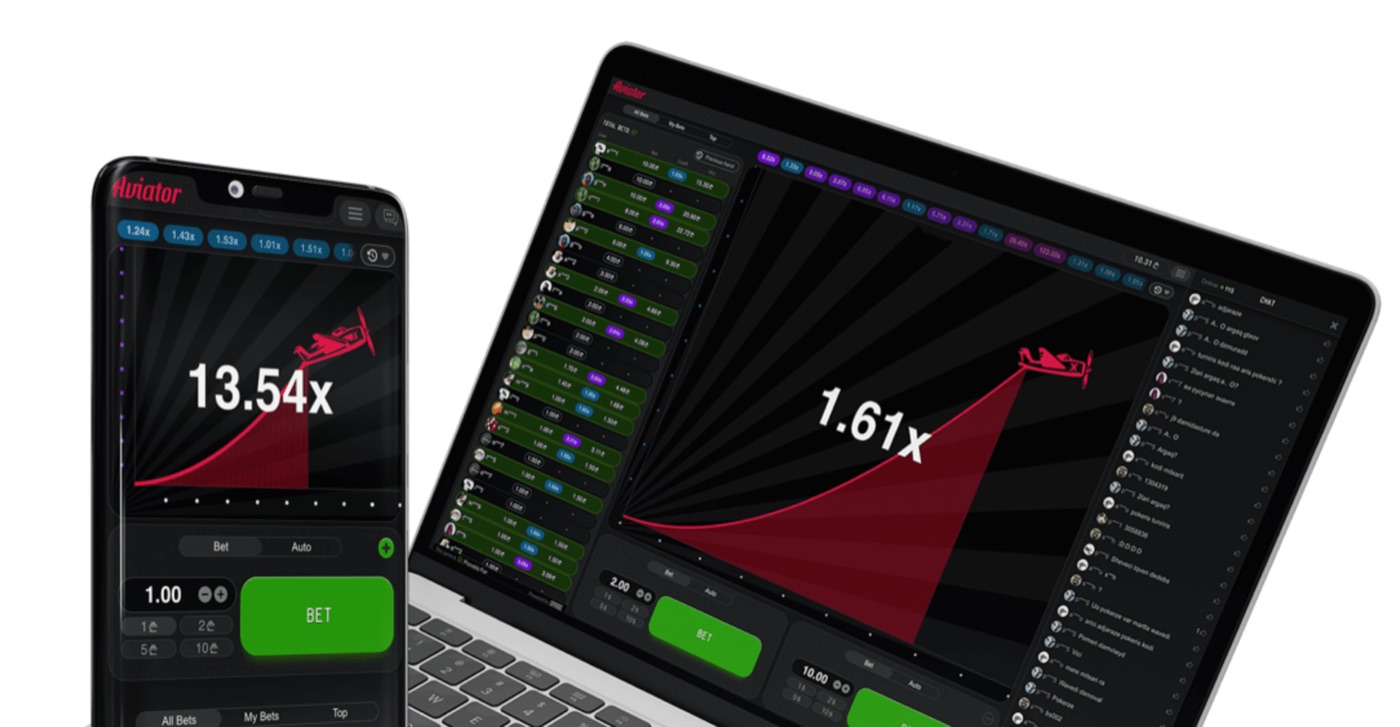
Aviator can show different round multipliers on phone and laptop screens.
A 1.00x crash can feel unusual because it gives no time for a manual cash-out. That feeling does not make the outcome less likely or more likely in the next round. The approximate 3% rate applies across the round model, not to a player’s personal sequence.
Players also need to separate the game’s edge from an operator’s individual rules. Typical stakes range from about $0.10 to $100 per bet, but the available amount depends on the operator. Win caps per round are also set by each operator.
Cash-Out And Timing
Aviator’s cash-out request must reach the server before the crash. A cash-out time-out can result from latency or a slow device, but it does not change the predetermined crash point.
The interface shows live bets, previous multipliers, chat and a Provably Fair badge. These displays provide information about the round and other players, but they do not delay the crash or extend the cash-out window.
Manual cash-out requires the player to act while the multiplier is moving. Auto Cash-Out uses a preset multiplier, so the game sends the instruction when that target is reached, provided the round has not already crashed.
For a crash game, a multiplier target, cash-out request and stake are separate choices; some players may also see a aviator download while researching ways to place a stake, but a separate download cannot change the game’s RTP.
The two-panel layout allows a split approach, such as one bet set to cash out at 1.50x and another left for a higher target. That arrangement can alter the pattern of wins and losses, but it does not alter the 3% edge on either stake.
- Manual Cash-Out depends on a request arriving before the crash.
- Auto Cash-Out uses a preset multiplier chosen by the player.
- Auto Bet and Auto Play can cover 10-100 rounds.
- Stop-on-win and stop-on-loss can end an automated sequence.
- A slow connection can affect the timing of a cash-out request.
The practical lesson is simple: a target near 1.50x may be reached more often than a target near 10.00x, but it is still exposed to the 1.00x instant-crash rate and the full house edge.
Fairness And Prediction
Aviator uses a SHA-256 hash of the server seed before each round. Player client seeds are combined with the server seed, and the inputs are revealed after the round for checking in the game’s verification tool.
The crash point is fixed before take-off, and neither Spribe nor the operator can change the result after the round starts. This process explains how the result can be checked without making it predictable before the round.
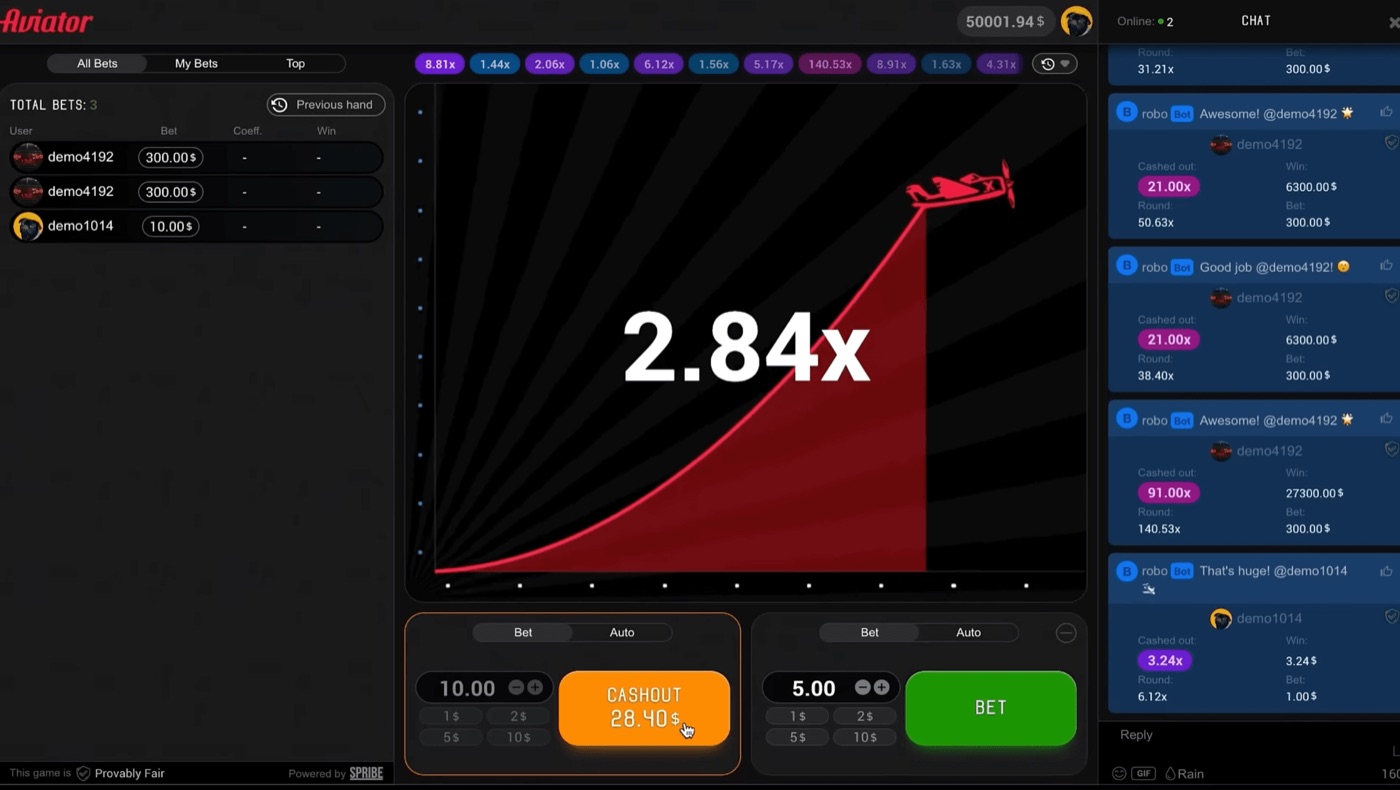
The interface combines live bets, in-game chat and a recorded 28.40x cash-out.
A hash is a way to commit to information without showing the original input. The pre-round hash shows that a server seed was committed, while the later reveal lets the player check the completed calculation.
That system does not predict whether the next round will crash at 1.00x, reach 2.00x or continue to a higher multiplier. Prediction apps, signal bots and chart-based systems cannot know the committed crash point in advance.
- Round history cannot forecast the next independent round.
- Graph analysis cannot change the probability formula.
- A strategy chart PDF cannot remove the 3% house edge.
- Telegram signal bots resell public maths rather than future results.
- Apps labelled “Predictor” are not a Spribe standalone app.
There is no standalone official Aviator app from Spribe. Aviator runs inside a licensed operator’s website or app, while third-party clones may use virtual coins, advertisements or disclaimers saying that their coins have no real value.
Controls And Bankroll Choices
Aviator’s Auto Cash-Out can use a preset multiplier, and the game also offers Auto Bet and Auto Play for 10-100 rounds. These controls automate actions, but they do not improve the 97% RTP.
Martingale, Fibonacci and D’Alembert systems all leave the 3% edge unchanged. Martingale also increases the stake after losses and reaches 1,024 times the base stake after 10 losses.
Some guides suggest cash-out targets between 1.50x and 2.00x, a two-bet split, or a stake of no more than 2% of the bankroll per round. These are betting approaches described by guides, not methods that overcome the game’s mathematics.
A player can use a demo mode without registration through an operator demo or demo.spribe.io. Starting with demo play can help explain the controls without placing a real stake, but it does not change the probabilities used in real rounds.
- Set a stake before the round instead of increasing it after a loss.
- Use loss and win limits where the operator provides them.
- Remember that a high target increases variance.
- Do not treat a previous 1.00x crash as a signal for the next round.
- Stop playing if the planned limit has been reached.
Only gamble with money you can afford to lose. The 1.00x rate means that instant losses are a normal part of the game, not evidence that a player is due a win.
Aviator FAQ
Aviator uses a 97% RTP and a 3% house edge. About 3% of rounds crash instantly at 1.00x, or roughly one in 33.
The crash point is committed before each round through the provably fair process. The result can be checked after the round, but no tool can predict it beforehand.
What is an instant 1.00x crash?
It is a round whose predetermined crash point is 1.00x. The round ends at the starting multiplier, so a stake that has not been cashed out loses.
Why does Aviator need instant crashes?
The instant crashes are part of the probability model that produces the stated 97% RTP and 3% house edge. They are not separate from the game’s normal mathematics.
Is one crash due after 32 rounds?
No. One in 33 is an approximate long-run rate, not a fixed sequence. Rounds are independent, so an instant crash can occur at any point.
Can a cash-out target remove the house edge?
No. The expected value is minus 3% of the stake at every cash-out target. A lower or higher target changes variance and win frequency, not the edge.
Can an app predict the next crash?
No. The crash point is fixed before take-off and protected by the provably fair process. Prediction apps and signal bots cannot reveal the result in advance.